Key Takeaways
- AI search is expanding how people discover businesses across search engines and AI platforms.
- SEO fundamentals still help search engines and AI systems find and understand your business.
- Clear content and credible third-party signals make your business easier for AI to understand and trust.
- Original research, expertise and useful resources give AI more reasons to reference your content.
- Your entire digital presence can influence whether your business appears in AI-generated answers.
Think about the last time you searched for something online.
Did you type in two or three keywords? Or did you ask a complete question?
A few years ago, you might have searched “estate planning attorney near me.”
Today, you might ask, “What’s the best law practice near me for a business owner who needs help with estate planning and succession?”
Or maybe you, like half of consumers polled by McKinsey, skipped the traditional search box altogether and asked ChatGPT, Gemini or Perplexity.
That’s increasingly how people search. We’re moving from typing keywords and sorting through links to asking specific, conversational questions and expecting useful answers in return.
And those answers are showing up in more places. Google now provides AI-generated responses through AI Overviews and AI Mode. ChatGPT, Gemini and Perplexity can search the web and incorporate current information into their answers. Microsoft has integrated generative AI into Bing and Copilot.
For businesses, being visible in search now means more than earning a spot near the top of Google search results pages, although SEO is still important. Potential customers may encounter your company in an AI-generated answer provided by an AI Overview, a ChatGPT response or a Perplexity recommendation before they ever visit your website.
How do those answers get created? And what makes one business or website more likely than another to become part of them?
Understanding how AI search finds and uses information can help explain why some traditional marketing practices still matter and why others are becoming more important.
What Happens When You Ask AI a Question?
There isn’t one universal process used by every AI platform. But AI-powered search increasingly combines the capabilities of large language models (LLMs) with information retrieval from the web.
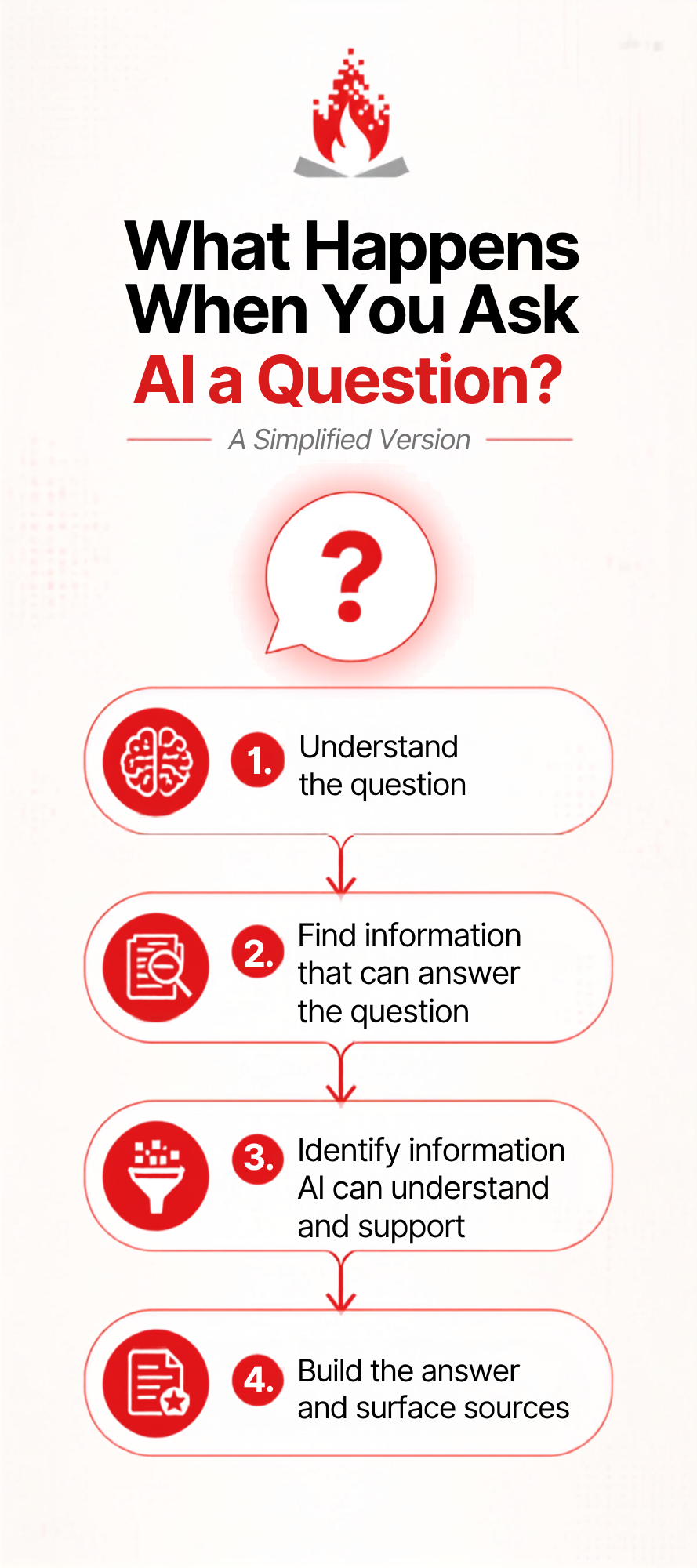
A simplified version looks something like this.
Understand the question
People aren’t limited to typing a few keywords anymore. When you type in a question, AI systems attempt to understand the meaning, context and intent behind that question.
That matters because your digital presence needs to clearly communicate more than a handful of target keywords. Search and AI systems need enough context to understand what your company does, who you serve, what problems you solve and where you have expertise.
Find information that can help answer the question
Depending on the platform and query, an AI system may use information it already has, retrieve current information from the web or combine the two.
And that retrieval can be more complicated than conducting a single search.
For example, Google’s AI search features can use query fan-out, expanding a user’s original question into related searches that investigate different subtopics and sources, then combining what they find into a single response.
A question about choosing a law firm that handles estate planning could trigger searches related to wills and trust expertise, business succession, elder care or special needs planning, real estate transfers, attorney credentials, fee structures and other factors.
That creates opportunities to be discovered across a much broader collection of topics than one target keyword.
Identify information AI can understand and support
AI systems aren’t only trying to identify webpages. They also need specific information that can help them construct an answer.Microsoft has described this evolution in terms of “groundable information”: specific information that can be supported and traced back to a reliable source.
That makes clarity important at multiple levels.
- Can a crawler access the page?
- Can the system understand how the website is organized?
- Does the page clearly communicate its topic?
- Are headings descriptive?
- Are important claims supported?
- Do internal links establish relationships between related topics?
- Do other credible websites reference the company or its information?
These aren’t exclusively “AI optimization” questions. Many are SEO fundamentals that become even more important when machines are trying to extract meaning from your digital presence.
Build the answer and surface sources
Finally, generative AI synthesizes the information it has found into an answer.
Depending on the platform and experience, it may provide citations, links, recommendations or other ways for users to explore the sources behind the response.
That creates another type of search visibility.
Rankings and website traffic still matter. But businesses also need to pay attention to whether their brands, expertise and webpages are being referenced or cited in AI-generated results.
There are now tools designed specifically to measure how brands show up in AI search. Bing Webmaster Tools, for example, reports when websites are cited across Microsoft’s AI experiences, while tools such as HubSpot AEO, Semrush’s AI Visibility Toolkit and Ahrefs Brand Radar track visibility across multiple AI platforms.
Depending on the tool, marketers can monitor AI mentions and citations, cited pages, share of voice, competitor visibility and even the questions or topics that trigger brand appearances. Search visibility now includes not only where your website ranks, but where your brand appears in the answers themselves.
What AI Search Tells Us About Getting Found
Understanding how AI search works is useful. But for marketers and business owners, the bigger question is what to do with that information.
If AI platforms are searching for information they can access, understand, support and confidently use in an answer, your digital presence needs to make things easy.
That doesn’t require abandoning SEO for an entirely new playbook. Google has specifically said that established SEO best practices remain relevant to its generative AI search experiences.
Many of the practices that help with AI visibility are the same ones that have long helped businesses perform in search. What’s changing is why they matter and how they work together.
Make Sure AI Can Access and Understand Your Website
Before an AI system can use information from your website, it needs to find and understand it.
That makes many of the technical SEO fundamentals you already know just as relevant to AI search. Crawlability, indexability, site speed, mobile usability and other technical factors can all affect how easily search engines access and interpret your website.
Site structure matters, too. A clear hierarchy helps communicate what your business does and how the information on your website relates.
For example, a core service page might connect to related subservice pages, FAQs, case studies, articles and videos. Thoughtful internal linking helps visitors move among those resources while giving search systems additional context about how the topics connect.
Structured data can provide even more context by helping search engines understand information about your organization, products, services, articles, videos and other elements of your website.
AI search may feel like entirely new technology, but the basic principle isn’t new: If your website is difficult to crawl, poorly organized or unclear about what it offers, you’re making it harder for both people and search systems to understand your business.
Make Your Content Easy to Understand
Content still plays a major role. But AI search reinforces the value of clarity over complexity.
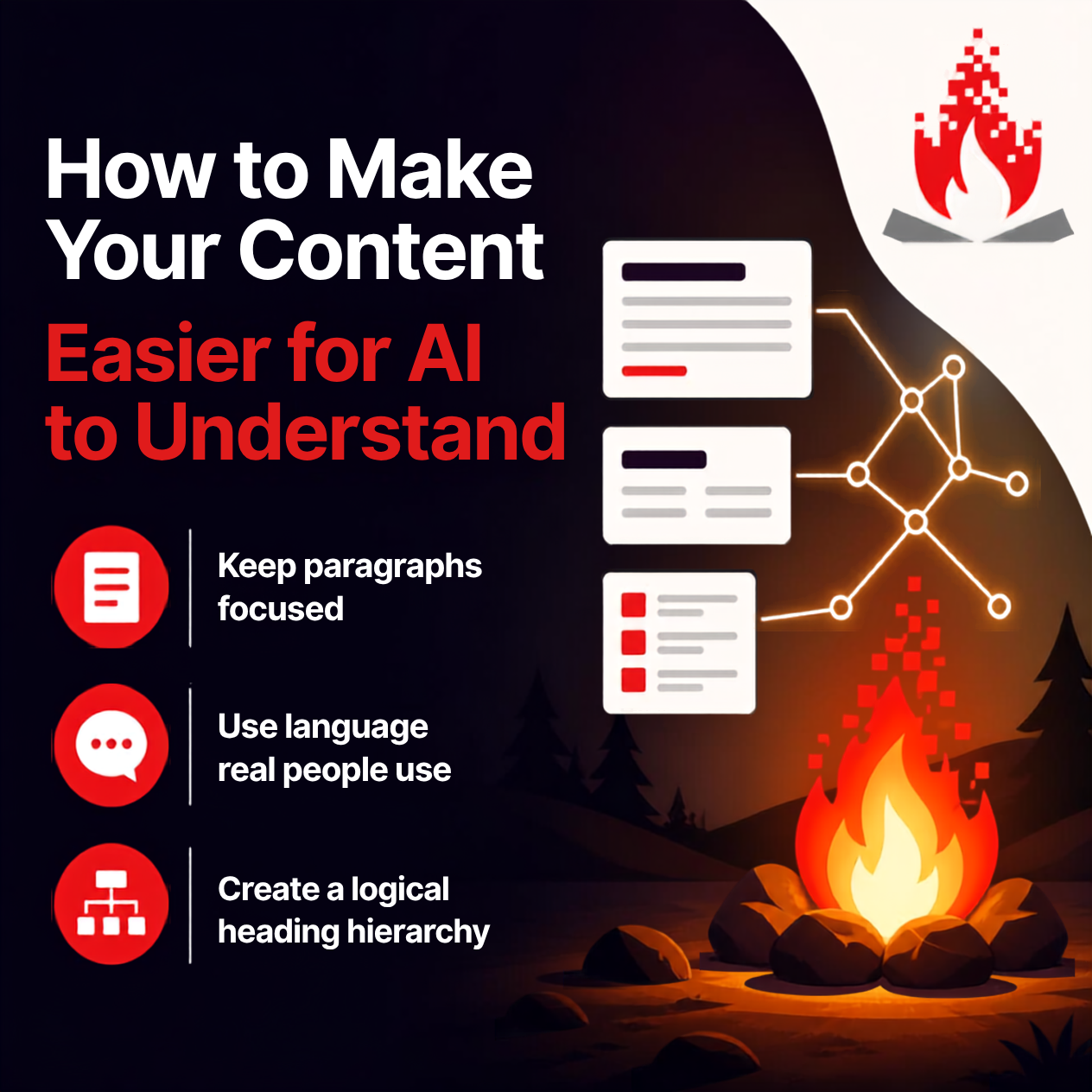
- Keep paragraphs focused. Dense blocks of copy make information difficult for people to scan and individual ideas harder to distinguish.
Keep paragraphs focused on a primary idea. When the idea changes, start another paragraph.
There isn’t a magic number of words that makes a paragraph AI-friendly. The goal is clarity.
- Use language real people use. You don’t need to “utilize” something when you can “use” it.
Clear language more closely reflects the way people ask questions and makes complex topics easier to understand. That doesn’t mean eliminating necessary industry terminology. It means eliminating complexity that doesn’t add meaning.
- Create a logical heading hierarchy. Headings aren’t just formatting. They communicate structure. Your H1 establishes the page’s primary topic. H2s define major sections. H3s organize supporting information. Make them descriptive whenever possible. “Additional Considerations” doesn’t tell you much. “How Does AI Search Choose Which Sources to Cite?” does.
Make Your Links More Meaningful
Links do more than move visitors from one page to another.
Internal links help establish relationships between topics and distribute authority throughout your website. External links can provide context and support claims. Backlinks from other websites can signal that other people consider your organization or information worth referencing.
The words used in those links matter, too.
Google has long recommended descriptive anchor text because it helps users and Google understand the destination.
Generic calls to action such as: “Read More” or “Click Here” provide very little context.
Instead, tell the visitor exactly what’s on the other side:
Learn what business owners need to consider before estate planning
or:
Explore our estate planning services for business owners
Descriptive links improve the user experience while providing machines with additional context.
Use Video as Part of Your Search Strategy
Search isn’t limited to written copy.
Relevant video can provide another way for audiences to discover and understand your business. Google can discover videos embedded on webpages, including YouTube videos embedded using an iframe. That creates another searchable asset associated with the page and another potential avenue for discovery.
A service page might include a 90-second explanation of the service. A complicated blog topic might include an expert answering the primary question. A case study might incorporate a customer explaining the results.
If you publish videos on YouTube, optimize the video itself as part of your search strategy. Use descriptive titles that clearly communicate the topic, write useful descriptions that include relevant links, and provide accurate transcripts or captions. Chapters can also help organize longer videos around specific topics. These details give search systems more context about what the video covers and make the content easier for people to find and use.
Video shouldn’t be added simply because someone told you “it helps AI rankings.”
It should make the page more useful.
And keep important information in the written page content, too. Don’t make a video the only place where a key answer exists.
Build Authority Beyond Your Own Website
You can say you’re an expert on your own website.
It’s more meaningful when the rest of the internet provides evidence.
Backlinks have always mattered for SEO, but they take on added significance when AI systems are looking for information that can be supported by sources beyond your own website.
Links from relevant, credible websites can help search engines understand authority and relationships across the web. Mentions, PR coverage, industry directories, associations, partnerships, reviews and other third-party signals can also contribute to the broader digital footprint surrounding a brand.
For businesses, that makes digital PR, link building and brand visibility part of the AI-search conversation.
Give AI Something Worth Citing
You can perfectly structure an article. Use short paragraphs. Add descriptive headings. Include a video. Fix every generic link on the page.
But what if the article says exactly the same thing as 500 other articles?
Why should an AI system use yours?
As generative AI makes average content faster and cheaper to produce, originality becomes more valuable.
That means asking a different question before creating your next piece of content:
What are we adding that isn’t already available everywhere else?
That could include:
- Original research or proprietary data
- Firsthand expertise
- Customer stories and case studies
- Expert interviews and quotes
- Proprietary frameworks or methodologies
- Original images and video
- Useful tools or resources
- A well-supported point of view
Technical optimization can help machines find your information. It can’t make generic information distinctive.
Think About Your Entire Digital Footprint
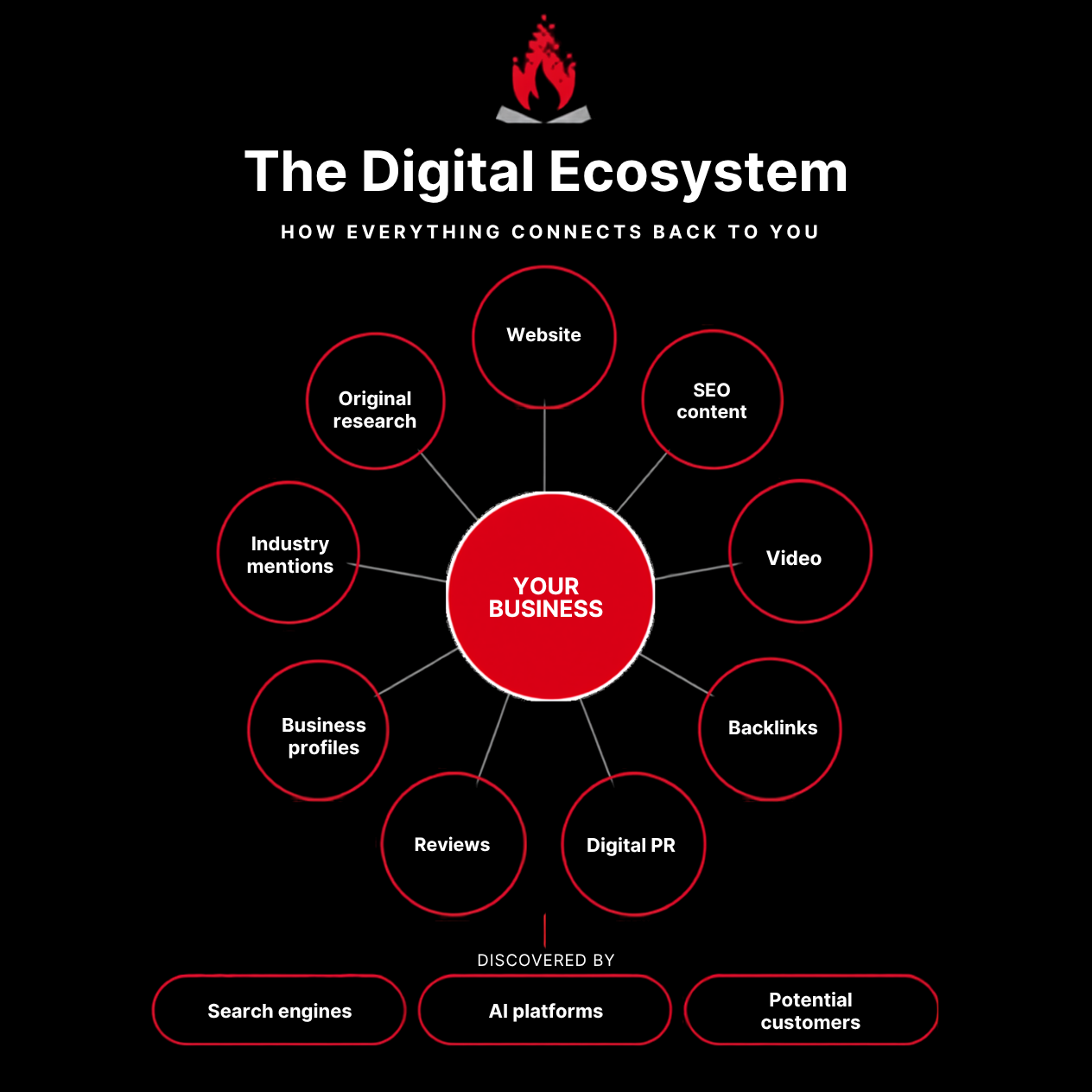
AI search makes it increasingly difficult to think about digital marketing channels in isolation.
Your website helps establish who you are and what you offer. SEO helps search engines discover and understand that information. Content demonstrates expertise. Video gives people another way to engage with and discover your brand. Backlinks and digital PR build authority beyond your own site. Reviews, business profiles and third-party mentions add to the larger picture of your brand across the web.
Those signals don’t all work the same way, and there isn’t one formula AI platforms use to evaluate them. But together, they create a more complete digital presence for search engines, AI platforms and, ultimately, potential customers to discover.
That’s why optimizing for AI search shouldn’t be treated as a standalone marketing tactic. It’s another reason to make sure the pieces of your digital strategy are working together.
SEO Isn’t Being Replaced. Search Is Expanding.
With all the attention being paid to AI search, businesses might assume they need to replace traditional SEO with an entirely new optimization strategy.
They don’t.
Google says traditional SEO fundamentals remain foundational to visibility in its generative AI experiences. AI platforms still need to discover information, understand what it’s about and determine whether it’s credible enough to use.
What is changing is the number of places and ways in which your business can appear.
A potential customer might discover you through a traditional organic result. They might encounter your brand in a Google AI Overview. They might see one of your pages cited by Copilot or Perplexity. Or ChatGPT might surface your company while helping them research a problem.
That means the goal isn’t simply to rank No. 1 for a particular phrase.
It’s to build a digital presence strong enough that when people and the AI systems helping them look for expertise in your space, your business has a chance to become part of the answer.
Building Visibility for the Way People Search Today
AI search may feel like an entirely new frontier, but much of what makes a business visible isn’t new.
You still need a website search engines can access. You still need useful information that answers real questions. You still need a clear site structure, authoritative links, strong third-party signals and content people consider worth sharing.
What’s changing is how those pieces work together and the number of places where they can help your business get discovered.
Your website isn’t competing only for a position on a search results page anymore. Pieces of your digital presence can become sources for the answers people receive from Google, ChatGPT, Gemini, Perplexity and other AI-powered search experiences.
Understanding how AI search works helps you build a digital presence that’s easier to find, easier to understand and more likely to become part of those answers.
Want to know how prepared your digital presence is for AI-powered search? Schedule a digital marketing consultation with Campfire Digital to discuss your SEO, website, content and digital visibility strategy.