Key Takeaways:
- AI-powered search became a more significant part of the customer journey in 2026, making visibility beyond Google rankings increasingly important.
- As AI made content easier to produce, firsthand expertise, fresh perspectives and useful information became more important for standing out.
- Consumers increasingly moved between AI search, traditional search, social media and websites before making purchasing decisions.
- Marketing fundamentals, such as strong SEO, quality website content and a clear strategy, continued to drive results, even as new technologies changed how businesses reached customers.
At the beginning of 2026, we wrote about the digital marketing trends we expected to shape the year. From AI-powered search and advertising automation to zero-click searches and first-party data, we anticipated some significant changes.
Some of those predictions played out as expected. Others accelerated faster than we anticipated. And a few developments, including the arrival of advertising in AI-powered search, introduced opportunities we hadn’t fully anticipated.
As we look back at 2026, we’re revisiting those predictions, exploring what actually happened and sharing what we’ve learned from helping our clients navigate the changes.
AI Search Became a Bigger Part of How Customers Find Businesses
One of the biggest changes in digital marketing this year was how people used AI to find information about businesses.
At the beginning of the year, we predicted that generative engine optimization (GEO) would become increasingly important as AI changed how people searched for information. We also anticipated continued growth in zero-click searches, making it more important for businesses to measure visibility beyond website traffic.
Both trends accelerated.
The Stats on AI Search Behavior in 2026
Customers increasingly turned to tools like ChatGPT and Google’s AI-powered search experiences to research products, compare services and get recommendations. According to SOCi’s 2026 Local Discovery Index, 52% of surveyed consumers used an AI tool to find a local business in the previous 30 days, compared with just 9% in 2025.
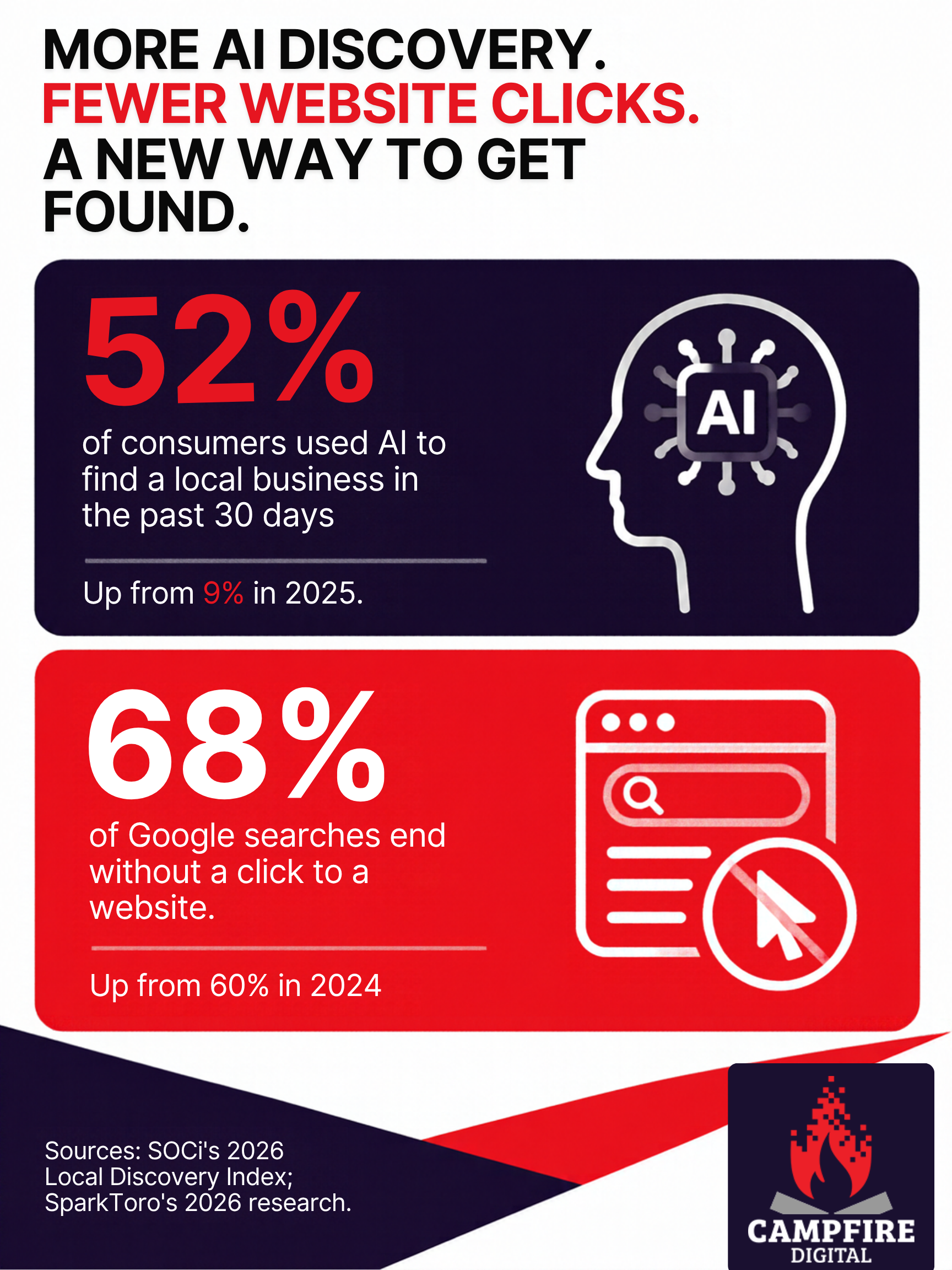
Meanwhile, more searches ended without a visit to a website. According to SparkToro’s 2026 research, approximately 68% of U.S. Google searches ended without a click during the first four months of the year. That’s up from about 60% in 2024. The research also found that when Google’s AI Overviews appeared, click-through rates dropped by nearly 60%.
But fewer clicks don’t necessarily mean fewer opportunities. Branded searches, local searches and searches with strong purchase intent continue to bring customers to websites. And appearing in AI-generated answers can help businesses build visibility, even when someone doesn’t immediately click through.
Real Results from a Combined SEO and AEO Strategy
For small businesses, this changes SEO success. Rankings and website traffic still matter, but so do brand exposure, AI citations and, ultimately, the leads and customers that marketing generates.
We’ve seen firsthand how traditional SEO and AI search optimization can work together. When we began working with Mile High Legal, a new Denver-area law firm, the business needed to establish its online presence in a highly competitive market. We developed a new website and implemented an SEO and answer engine optimization (AEO) strategy designed to improve visibility in both traditional and AI-powered search.
Over nine months, organic traffic increased 1,255%, keywords ranking in Google’s top 10 grew 450% and AI citations increased 225%. The firm also generated 145 lead form submissions from organic search between January and July 2026.
What it means for you: Don’t abandon SEO for the latest AI optimization tactics. A strong website, useful content and sound SEO practices can support visibility across both. Continue strengthening those fundamentals as you expand how you measure your business’s visibility and marketing results.
For a deeper look, read our article on how AI search works and what it takes to get found.
AI Made Content Easier to Produce, but Harder to Differentiate
Throughout 2026, AI tools made content creation, research, brainstorming and marketing execution more accessible to businesses of all sizes. Small marketing teams gained capabilities that once required significantly more time and resources.
But when almost anyone can generate a blog post or dozens of social media updates in minutes, simply producing more content isn’t much of a competitive advantage. And when businesses rely on the same tools to produce similar content, they risk sounding like everyone else.
That makes original thinking, firsthand experience and subject-matter expertise even more valuable.
Consider two businesses publishing articles about the same topic. One offers a general overview that could apply to almost any company. The other includes specific customer questions, examples from actual projects and insights based on years of experience.
Which one is more likely to help a prospective customer make a decision?
The second article offers something the reader can’t easily find elsewhere. It also gives search engines and AI platforms more distinctive information to potentially reference.
What it means for you: Focus on producing content that reflects what your business actually knows. Customer stories, expert perspectives, practical advice and original insights can help distinguish your brand.
The Customer Journey Became More Complicated
Customers have always used multiple sources to research businesses, but in 2026, the number of places they could discover and evaluate a company continued to expand.
Someone might first encounter your company in an Instagram video, ask ChatGPT for recommendations, check Google reviews, visit your website and finally reach out after seeing a retargeting ad.
BrightLocal’s 2026 consumer search research found that three out of four consumers used multiple channels during their most recent search for a local business. The research also found that people who started their search with AI often turned to Google or social media to verify the information they received.
That means appearing in an AI-generated recommendation is valuable, but it’s not necessarily enough to earn a customer’s business.
What happens when that customer looks you up elsewhere?
Do they find an updated website, positive reviews and clear information about your products and services? Or do they encounter inconsistent messaging, outdated information and unanswered questions?
What it means for you: Think about your digital presence as a connected experience rather than a collection of separate marketing channels. Customers should encounter a consistent, credible picture of your business wherever they find you.
Digital Advertising Became More Automated and Found a New Channel
At the beginning of 2026, we predicted that digital advertising would become more automated, more competitive, and increasingly dependent on strong creative content and accurate customer data.
That prediction largely held true. Platforms like Google and Meta continued expanding AI-powered tools to help advertisers manage targeting, optimize campaigns and improve performance.
But one of the year’s biggest surprises was the emergence of an entirely new advertising channel: AI platforms like ChatGPT.
AI Advertising was Introduced
In February, OpenAI began testing advertising in ChatGPT. By May, it had introduced cost-per-click bidding and beta self-service advertising tools, making it easier for businesses of different sizes to participate. Google also began testing new advertising formats within AI Mode, creating additional opportunities for businesses to reach customers as they research products and services.
Advertising on AI platforms gives small businesses another way to reach potential customers, but it’s still a relatively new opportunity. Before investing heavily in these placements, businesses should test their effectiveness and make sure they’re reaching the right audiences and generating results.
And even as advertising platforms grow more sophisticated, automation doesn’t eliminate the need for strategy. Strong messaging, compelling creative, clear campaign objectives and reliable conversion data are still important.
As advertising became more automated, another prediction from January held true: the importance of first-party data. Accurate customer information collected directly through websites, CRM systems and email marketing helps businesses improve targeting, personalize communications and measure campaign performance. And as we anticipated, consent and transparency are critical.
What it means for you: Keep focusing on the advertising channels that deliver results while watching emerging AI advertising opportunities. Before testing a new platform, set clear goals and a way to measure performance.
Measuring Marketing Success Became More Challenging
Website traffic and search rankings still matter, but they don’t always show how well your marketing is working. Customers may discover your business through AI search and other channels without ever visiting your website. And even when traffic increases, that doesn’t necessarily mean you’re attracting more potential customers.
A thousand website visitors who aren’t interested in your services may be worth less than 50 highly qualified prospects who are ready to buy.
What Meaningful Marketing Results Looks Like
We worked with 5.12 Solutions, an executive coaching and consulting firm, to strengthen its website and improve visibility in both traditional and AI-powered search.
Between February and July 2026, new site visitors increased 116%, while the engagement rate rose from 7.36% to 31.35%. The number of pages cited by AI search tools also increased 40%.
Interestingly, the website ranked for fewer total keywords by the end of the campaign, but the keywords driving traffic were more closely aligned with the firm’s services.
The results reinforce why businesses need to evaluate marketing performance based on more than traffic and rankings. Depending on your goals, meaningful outcomes could include qualified leads, consultation requests, sales, customer acquisition costs, conversion rates or repeat business.
What it means for you: Review what you’re measuring and why. Website traffic and rankings are useful, but they should be part of a broader picture that connects your marketing efforts to leads, customers and revenue.
What Didn’t Change in Digital Marketing in 2026?
Despite all the attention on AI, automation and changing search behavior, the fundamentals of effective digital marketing haven’t changed nearly as much as the technology.
Businesses still need to understand their customers, communicate what makes them different and earn trust.
A well-designed website remains important, even when customers discover your business through AI or social media. That means paying attention to more than just appearance. A site that’s fast, mobile-friendly, technically sound and easy to navigate helps visitors find what they need while making content more accessible to search engines. Clear headings, useful answers to customer questions and well-organized information can also make it easier for AI-powered search systems to understand and reference your content.
Helpful content still matters. So do customer reviews, clear messaging and a consistent brand presence.
In fact, some of these fundamentals have become more important because customers have more ways to evaluate businesses before contacting them.
SOCi’s 2026 research found that 67% of consumers using AI had encountered incorrect information about a local business. The research also found that 81% verified information before contacting a business.
That’s a reminder that businesses can’t rely on a single platform to tell their story accurately.
They need a strong digital foundation that helps customers confirm what they offer, understand why they should choose them and feel confident taking the next step.
The tools may change, but those objectives remain remarkably consistent.
The Biggest Lesson From 2026? Strategy Still Matters.
Looking back at our predictions from January, some of the biggest changes in digital marketing played out as expected. Others, particularly the growth of AI search and the emergence of advertising within AI platforms, happened faster than we anticipated.
But perhaps the biggest lesson from 2026 is that keeping up with digital marketing doesn’t mean chasing every new trend or technology.
It means understanding how changes in technology and customer behavior affect your business, then making thoughtful decisions about where to invest your time and resources.
At Campfire Digital, we build digital marketing strategies that account for changes in technology and customer behavior while staying focused on your business goals. Whether you’re looking to improve your search visibility, build a better website or get more results from your marketing investment, let’s talk about how Campfire Digital can help.
Frequently Asked Questions About Digital Marketing in 2026
How did AI change digital marketing in 2026?
AI changed how businesses created content, managed campaigns and connected with customers. One of the biggest shifts was the growth of AI-powered search, which gave consumers new ways to research products, compare services and discover businesses. Marketers also gained access to more sophisticated tools for content creation, advertising and automation.
Is traditional SEO still important with the growth of AI search?
Yes. Traditional SEO remains an important part of digital marketing. Many of the practices that support Google search visibility, including helpful content, strong website performance and clear business information, also support visibility in AI-powered search. Businesses increasingly need to consider both traditional SEO and AI search optimization as part of their digital marketing strategies.
How has AI affected content marketing for small businesses?
AI has made it faster and easier for small businesses to create blogs, emails, social media posts and other marketing content. However, the growing volume of AI-generated content has also made differentiation more challenging. Content that includes original insights, firsthand experience, customer examples and subject-matter expertise can help businesses stand out.
Why is it harder to measure digital marketing success?
Customers now interact with businesses across more channels, including AI search tools, traditional search engines, social media and websites. Some of those interactions may not generate measurable website visits, making it harder to track the complete customer journey. Businesses need to look beyond traffic and rankings to evaluate qualified leads, conversions and other meaningful outcomes.
How did zero-click searches affect small business marketing in 2026?
Zero-click searches made it harder to evaluate SEO performance based on website visits alone. As more consumers found answers directly in search results and AI-generated responses, businesses needed to consider additional measures of visibility, including brand mentions, AI citations and qualified leads.